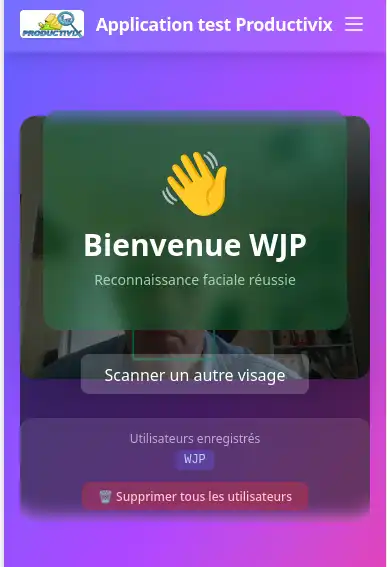
Automatic login via private facial recognition
Login issues in workplace applications
In manufacturing, logistics, maintenance and healthcare, traditional logins present three major problems:
- ❌ Time wasted: Repeated data entry, forgotten or shared passwords.
- ❌ Security risks: Unauthorised access, compromised traceability.
- ❌ User inconvenience: A less-than-intuitive experience for operators.
Based on these findings, at Productivix, we have developed a facial recognition solution that we will be rolling out from June 2026.
What is the purpose of facial recognition?
- ✔ Identify the operator in under 1 second (configurable accuracy).
- ✔ Ensure GDPR compliance: Data stored locally, no cloud sharing.
- ✔ Adapt to your processes: Access rights managed by administrator, automatic logout, compatible with all devices (PCs, tablets, smartphones, all brands/OS). 📌 2-minute demo: Watch the YouTube demo
💡 Why is this a game-changer for your business?
- Increased productivity: Less time wasted on authentication.
- Enhanced security: Eliminate the risks associated with shared passwords; facial signatures remain within your company’s data and are not published elsewhere (GDPR).
- Reliable traceability: Every action is linked to a clearly identified user.
🇪🇺 European legal framework
Before installing this feature, the following points must be considered:
✅ Biometric data is treated as sensitive data (Article 9 of the GDPR) :
- Explicit consent required for each user.
- No centralised storage: Facial templates are encrypted and stored locally on the operator’s device (PC, tablet, smartphone).
✅ Data Protection Impact Assessment (DPIA) carried out :
- Compliant with Article 35 of the GDPR, with risk assessment for the rights and freedoms of employees.
✅ Consultation of employee representatives :
- Deployment validated by works councils or other representative bodies, as required by the national labour law of each country.
✅ Compliance with the proportionality principle :
- Facial recognition is used only for authentication (no surveillance or performance tracking).
- Alternatives (badges, PIN codes) are offered to employees who prefer not to use this feature.
✅ No data sharing :
- No transmission to third parties or cloud storage. Data remains exclusively on users’ devices.
Special cases and exceptions ⚠️
Access to high-risk areas (e.g. laboratories, nuclear sites): Facial recognition may be justified if no other solution offers an equivalent level of security and the processing is covered by a national decree or regulation (after consultation with the local data protection authority).
Regulated sectors (e.g. defence, aeronautics): Derogations exist but require a specific legal framework (e.g. law or decree).
Country-specific adaptations for Europe
🇩🇪 Germany
- The Bundesdatenschutzgesetz (BDSG) supplements the GDPR with stricter rules on employee data processing (§26 BDSG).
- Consultation of the Betriebsrat (works council) is mandatory under the Betriebsverfassungsgesetz.
- The Berliner Beauftragte für Datenschutz und Informationsfreiheit has specifically warned against biometric systems for time tracking.
- A DPIA is mandatory and must be documented.
🇮🇹 Italy
- The Garante per la protezione dei dati personali requires strict compliance with the Codice della Privacy (Legislative Decree 196/2003 as amended).
- Prior authorisation from the Garante may be required for biometric processing.
- Trade union agreement (accordo sindacale) is recommended before deployment.
- The employee’s right to an alternative authentication method is particularly enforced.
🇪🇸 Spain
- The Agencia Española de Protección de Datos (AEPD) applies the Ley Orgánica de Protección de Datos (LOPDGDD) which transposes the GDPR.
- Prior consultation with the AEPD is required for biometric data processing in the workplace.
- Agreement with employee representatives (representantes de los trabajadores) is mandatory.
- The AEPD has published specific guidelines on facial recognition in the workplace, requiring strict proportionality.
Common European requirements summary
| Requirement | 🇫🇷 France | 🇩🇪 Germany | 🇮🇹 Italy | 🇪🇸 Spain |
|---|---|---|---|---|
| DPIA required | ✅ Yes | ✅ Yes | ✅ Yes | ✅ Yes |
| Employee consent | Explicit & free | Explicit + BDSG §26 | Explicit + Privacy Code | Explicit + LOPDGDD |
| Works council consultation | CSE (Social and Economic Committee) | Betriebsrat | Trade union agreement | Employee representatives |
| Local DPA notification | CNIL | BfDI / local DPA | Garante (prior authorisation) | AEPD (prior consultation) |
| Local storage only | ✅ Mandatory | ✅ Mandatory | ✅ Mandatory | ✅ Mandatory |
| Alternatives mandatory | ✅ Yes | ✅ Yes | ✅ Yes | ✅ Yes |
❔ FAQ: Your questions on facial recognition
🔹 Is this legal in Europe?
Yes, provided that the GDPR and the recommendations of the national data protection authorities are respected:
- Explicit and free consent from employees.
- DPIA carried out and consultation of employee representatives.
- Local data storage (no cloud).
- Purpose limited to authentication.
🔹 What happens if an employee refuses?
No problem! We always propose an alternative (e.g. RFID badge, PIN code). Facial recognition is optional.
🔹 Where is the biometric data stored?
Exclusively on the user’s device (PC, smartphone, tablet) in the form of an encrypted template (array of numbers, vectors). No data is sent to our servers or shared with third parties.
🔹 Can this solution be used for time tracking?
No. European data protection authorities consider facial recognition disproportionate for simple time tracking if alternatives (badges, codes) exist. Our solution is designed for authentication on traceability applications, not for working time management.
🔹 How do you guarantee data does not leak?
- Local encryption.
- No internet connection required for authentication.
🔹 Do I need to contact my national data protection authority?
It depends on your country. We recommend checking with your local authority. For countries not listed above, we will study the legislation before any development.
For any other country or legislation
We study the case and legislation before any development request.
You can ask us for the link to the test app to try it out for yourself!
Productivix Services – Installation, integration, consulting and mobile app development
Encryption and product authentication by barcodes and RFID
Innovation – Reinventing data acquisition and digital transformation
Native Android barcode scanning and OCR applications
Universal Web PWA applications – Multi-platform barcode and OCR data capture
Retail
Field-service
Health
Logistique,transports,SCM, production
Categories :
Industries :